May 29th, 2026
8:00pm
I arrived at the Eldorado peak trailhead alone and slightly nervous. The trailhead was bustling with people setting up tents, brushing their teeth and getting ready to do the same thing as me, most of them in teams of two or three. Earlier that week I had been sitting at the kitchen table lamenting a lack of alpine days and how much I really “just wanted to walk for a long time by myself.” Every once in a while I get a real hankering for a solo objective.
One of our friends had soloed Eldo a couple weeks earlier and splitboarded down. The photos of his descent under bluebird skies enticed me to strap skis to my pack and set out looking for my usual ill-advised mountain bounty: to return changed after a long, long day.
**As a note to the reader / disclaimer, Eldorado peak is glaciated. Traveling unroped on a glacier is hazardous. This post is not advocating for solo travel on glaciers or on Eldorado peak and is simply an account of my experience.
The route begins just downstream of where Eldorado creek meets the Cascade River. I had been advised ahead of time that this creek crossing is deep and fast, so I decided to scope it out before going to bed. From the parking lot, I followed a short dirt path to the creek. Intimidating water surged through the middle, with recirculating eddies on the sides. The best way across appeared to be a straight shot, but I couldn’t pick out another trail on the other side. There didn’t appear to be any other trails from the parking lot, so I shrugged it off and went to bed, wondering if maybe I would get a better view once I was further into the creek.
May 30th, 2026
1:00am
There’s something peaceful about an alpine start all by yourself. I packed my gear and I started moving right on time. I kept my approach shoes in my pack and decided to cross the creek in just my crocs and leggings. The creek was thundering, just as powerful as the evening before and icy cold. I unclipped my chest and shoulder straps, made a wide base for myself with both trekking poles and waded in. The water quickly reached my mid thighs and then my hips. The current pounded my bones, challenging my balance. I focused on controlling my breathing, moving slowly and methodically and shuffling sideways like a crab, facing upstream. I’m a strong swimmer, but water like this doesn’t negotiate. I knew that falling over would result in a long, turbulent ride downstream.
Luckily, the far side of the creek was shallower. This was a short-lived victory. Where I had hoped to see the trail, there was an impenetrable wall of bush. I looked back at the roiling water. “Nope,” I thought to myself, “I’m not doing that again,” and stepped onto the bank.
Almost immediately after I entered the bushes, my leg sank up to my hip into a pit of rotting, thorny vegetation. Upon pulling my soggy, croc-protected foot (sport mode of course) out of the hole, I realized a growing stinging sensation all over my legs and arms. I had postholed into a pit of pure stinging nettle. The next forty-five minutes were a dragging odyssey of bushwack in which I embedded splinters in every exposed inch of skin and the vines attempted to pull my skis off my pack. I screamed, thrashed and cursed my way all of fifty feet or so before bursting suddenly into empty space. I had finally found the trail!
1:50am
Elated and almost an hour behind schedule, I removed my crocs and stashed them next to a tree. I set a waypoint on my garmin, switched to approach shoes and set off up the trail.
The bottom 2000ft or so of forest is mostly unremarkable, especially in the dark. It’s steep and winds around protruding roots and rocks. I stopped for a snack break around 3:30am and spent much of this section singing to ward off bears and the lurking shadows of my imagination. If there were any bears in the area, but if there were, they probably got rickrolled.
I found the third class step successfully, but climbed up on the left (wrong) side. After a thoughtful move off of some good chips and an undercling, it occurred to me that no third class move would have an undercling. Oops. Anyways, go climber’s right. I went to set a way point and in the process fatfingered and heartbreakingly deleted the waypoint I had set for my crocs. Then came the boulder field.
The boulder field is long and is the subject of much kvetching among Eldo visitors. It’s probably a mile of mini-fridge to car sized boulders that requires a good bit of coordination to navigate. I didn’t find it too challenging on the way up, especially since being alone meant I wasn’t annoying anyone with my slow, measured pace. I watched the sun rise and bathe the peaks opposite me as I made my way up.
6:30am
Another climber caught up to me in the upper boulder field, where the trail crosses to the climber’s right again and winds through a brief section of scrubby trees. Upon reaching the first snowfield, I was joined by two more parties of two, all of which had skis.
I had crampons with me, but opted to boot up in just my approach shoes, as putting the crampons on would require putting my ski boots on. I chatted intermittently with the other parties as we made our way along the sloping ridgeline. We reached the 4th class downclimb in the midmorning, perhaps 8 or 9am.
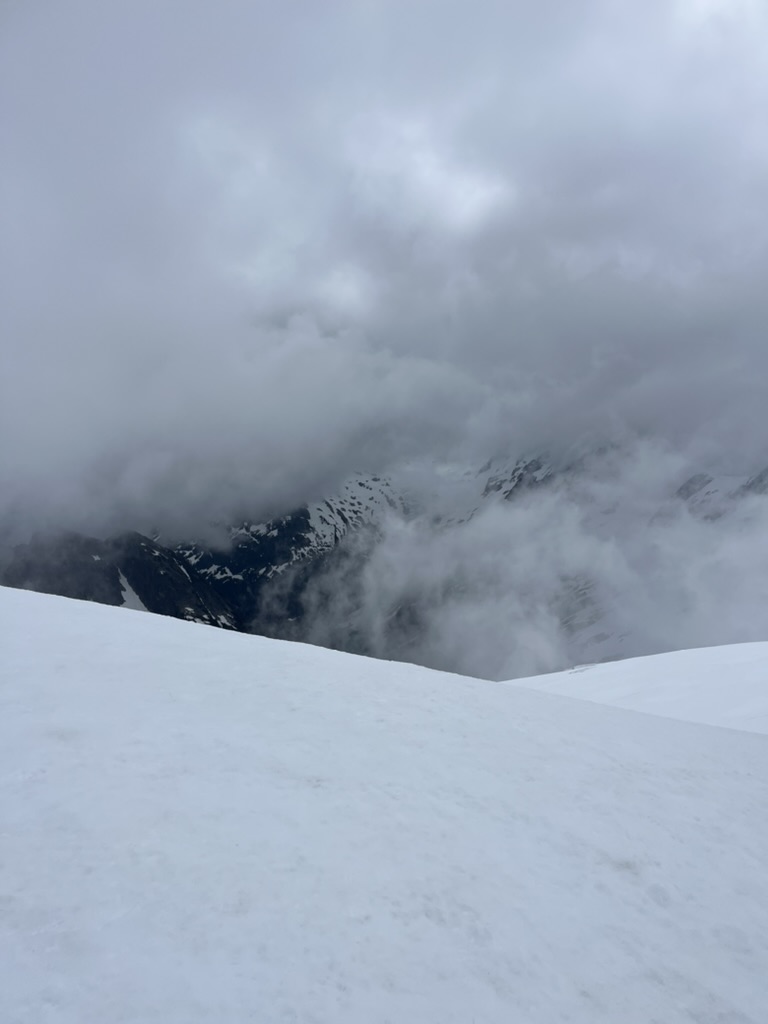
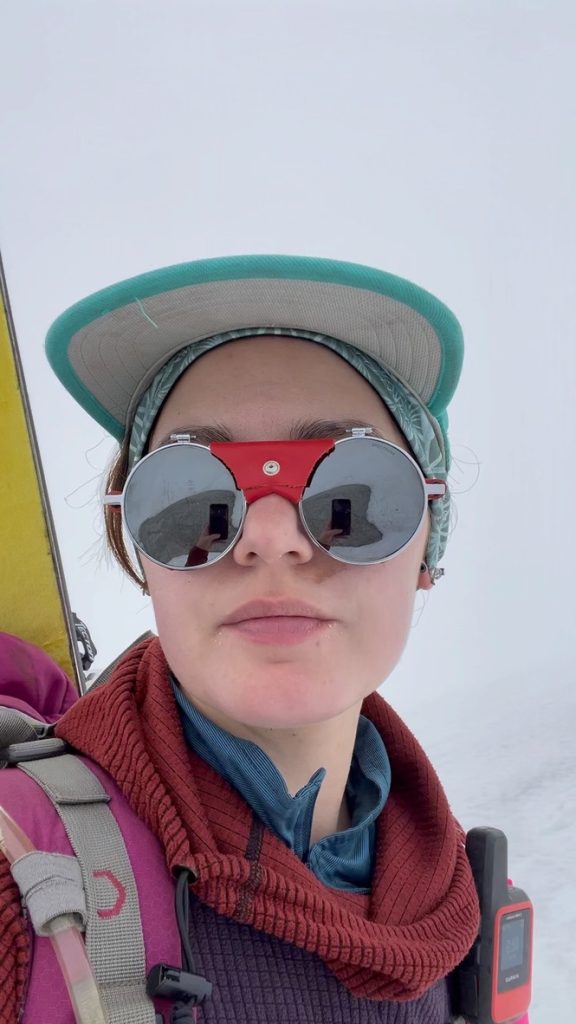
The downclimb follows a moderate and juggy gulley before emptying out onto a wide, low angle slab. I made quick work of it and continued onto the glacier. The sun had been up for some time at this point, but a thick fog covered the upper part of the mountain. The visibility fluctuated around 50 meters. I could sense the craggy wall of the ridge to my right, but couldn’t see it for much of the section.
11:00am
I stopped just behind another party for a break and to transition to skins. I regretfully noted as I was passed by another soloist on skis (wearing jean shorts) that I probably could have transitioned some time earlier.
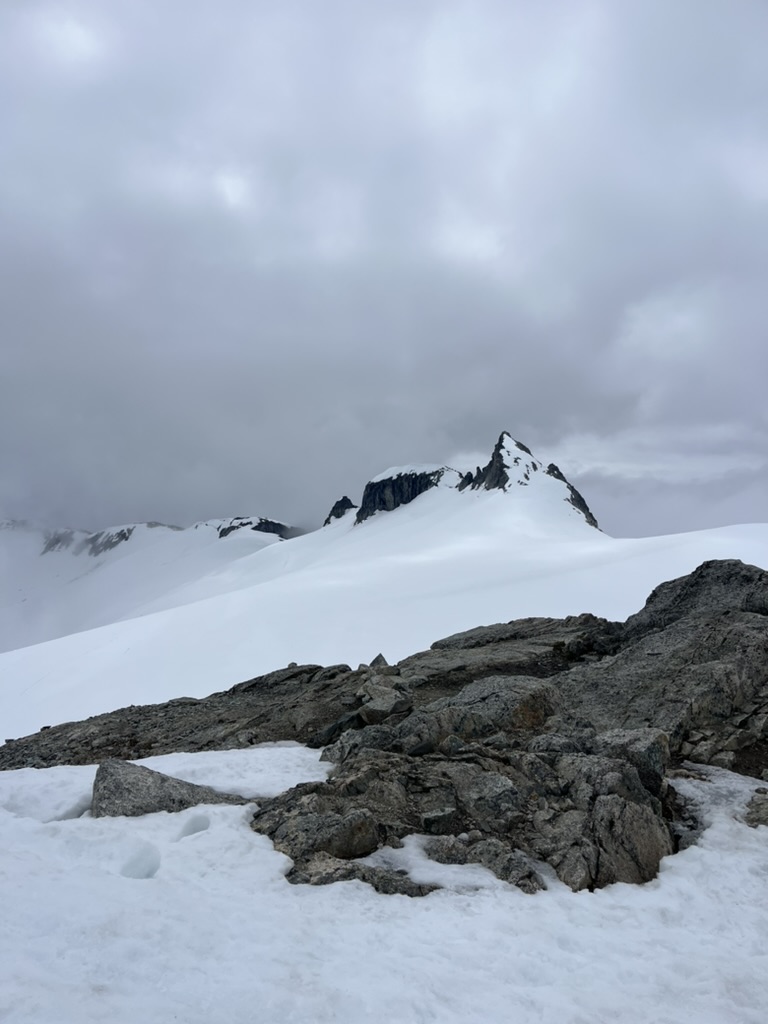
The skinning from this point went quickly and pleasantly, and the visibility improved marginally as I gained elevation. I reached the flat basin of the Eldorado Glacier at 7500ft around 11:30. While I could see across the basin and even all the way to Moraine Lake in some places, the summit ridge was covered in thick clouds. I gained the ridge and was immediately immersed. Thinking of the cliff to my left and active glacier to my right, I turned around at 7900ft, uncomfortable with traveling solo through the thick clouds with known hazards to both sides.
12:00pm
The snow had been warming slowly throughout the morning, culminating in a glorious ski descent off the ridge. Dropping below the clouds, I bombed it across the Eldorado Glacier, following the obvious compression zone down. It was pure type 1 fun all the way back to the 4th class gulley.
I decided to keep my ski boots on for the gulley, thinking I would just put my skis back on and ski off the opposite side of the ridge. This was an error. Rigid with smooth plastic bottoms, my boots dry-fired off the slab with every minute movement. I didn’t want to risk sliding all the way back down to the glacier, so I hauled myself ungracefully up the gulley relying on my hands and knees.
Topping out the ridge, I looked down the 40 degree snow slope on the other side and was met with a roughly thirty person guided mountaineering course grunting and shuffling up the bootpack. I didn’t want to try putting skis on standing on the steep, slick snow and risk toppling a domino chain of beginners, so I opted to keep the ski boots on and plunge step down to the skiers right of the boot pack. However, I had forgotten to remove my ice axe from my pack following my ascent of the gulley. I took exactly two steps down the slope before my ski boots betrayed me again and I was sliding on my back, picking up speed.
My worst nightmare was becoming a reality in mere seconds. I flipped over onto my belly and tried to dig into the snow with a trekking pole to no avail. Kicking my ski boots into the snow slowed me down, but it wasn’t enough to stop the fall. I was picking up speed and headed straight for a patch of exposed rock. “Here it comes, maybe if I relax my body I can get away with just a broken ankle or something,” I thought to myself. I ragdolled and hit the rocks feet first after sliding around fifty to a hundred feet (it was hard to tell in the moment), bouncing over them and catching a bit of air. My feet landed in a shallow moat below the rocks and I hinged at the hip, jack-knifing into the snow below and smacking my helmet. I sank into the moat, just in front of one of guided parties.
Immediately, one of the guides rushed towards me and helped me take my pack off. I did a quick body inventory. Nothing felt broken or numb. I was shocked and shaking, but still alert. The guide asked if I was alone, to which I replied yes. He then asked if I had an SOS device, which I did. Seeing as I was unharmed, he wished me a safe descent and encouraged his group to take their ice axes out and keep moving. I chose to stay where I was for a few minutes, letting the rest of the guided group walk around me.
Many people in the group felt the need to come talk to me while I rested and let the adrenaline dissipate. Most of them just asked if I was ok, but a handful wanted to make sure I was acutely aware that they thought I was stupid, reckless, and undeserving of their respect. I didn’t have any response for them. One woman seemed particularly unsatisfied by this. She emphasized at least twice that when she left, I would be alone. I insisted that I was well aware of this, and that I wanted to be alone. I was just grateful that this was a near miss and not a developing rescue situation.
With no choice but to continue downward, I skied the rest of the snowfield like I intended. The remaining on-foot descent was a long, exhausting trek. My stoke had all but completely disappeared after my sliding fall. My skis scraped along a mile of boulder field (now I understand the kvetching). Some younger lads also skiing down had heard tales of my unfortunate fate from the guided party and offered me some jelly beans as consolation. I think that was the most helpful response I encountered. I reached the car in the early evening, around 6pm.
Reflection
The sliding fall I experienced was due to two specific complacent decisions: I was lazy and didn’t take my ski boots off when I would have found it easier to move in my approach shoes (as I found during the 4th class gulley as well), and I didn’t take my ice axe out when descending the snow slope. This can be extended to a meager analysis of the fall consequences. I didn’t examine the runout of a potential fall, because I was wrongly convinced I wouldn’t fall. In general, I didn’t treat the terrain with enough respect and suffered the consequences. I’m grateful that I wasn’t more seriously hurt by those decisions.
How my behavior can change to protect my safety:
From now on, I can assess potential falls for every section of ascent or descent (not just particularly intimidating ones) and classify them by no-fall or yes-fall based on the slope angle, runout, snow conditions, and whether it’s possible to arrest a fall at all. This allows me to gather real, observable information about the consequences of a fall, and might have influenced my decision to get my ice axe out, change my shoes, or find a different route.
I also plan to treat transition opportunities with extreme caution. By not taking my ski boots off out of laziness, I accrued more risk than I was ok with. Any opportunity to transition (e.g. before the 4th class gulley, at the top of the ridge) deserves a proper assessment about what tools are needed for the job. This can be combined with fall consequence assessment. Having a set protocol for evaluating a transition point, for instance looking at the distance, angle, and obstacles below the ridge and then deciding what tools I needed instead of making emotional or ego-driven decisions about the transition would have allowed for a more intentional acquisition of risk.
Getting complacent is normal human behavior and we all do it. I am a human, so I will certainly become complacent again. The way I want to protect myself from this is by defining a protocol based on observable parts of my environment and re-training it often.
People have had lots of comments for me about the fact that I was soloing when this near miss occurred. All things considered, I still think the decision for me to be solo was appropriate. I had all of the skills and gear necessary to solo that terrain. I’m confident in my route finding skills on glaciers and rock up to 4th and low 5th class. I’m a proficient backcountry skier. I had all the tools with me to do the entire ascent and descent safely, accruing only the risk I was ok with. My near miss didn’t happen because I was soloing, it happened because I didn’t respond to the risk associated with that section intentionally.
On the topic of soloing:
I also want to point out that climbing with a team doesn’t ensure your safety beyond the skills and capabilities of that team. It is my responsibility as a climber to accrue risk appropriately for me, and I will never passively outsource my safety to other people on my team. I have a theory that people expect women in the mountains to shy away from taking the lead on hard decisions, let alone climb solo. Ultimately, the only person who decides if the climb is appropriate for me is me, regardless of what other people expect of me.
Overall review!
On a lighter note, Eldorado peak is a fantastic climb. It has a distinctly Cascadian wildness that sets it apart from a more well-traveled Mt. Baker or Mt. Rainier. Despite the inconvenience of bushwacking into stinging pits of stinging nettle and scraping your gear over a mile of boulder field, it makes you feel for a brief moment like you’re Fred Beckey questing into an unknown alpine. Except you get a parking lot at the end.
While unfortunately the low visibility kept me off the knife edge summit ridge, I look forward to coming back and seeing Eldorado in her full glory sometime. I certainly got what I came for, which was a gorgeous and transformative day in the alpine. You’re going to love it.
-M
Leave a Reply