Author: abovethebolt

  • Eldorado Peak

    May 29th, 2026

    8:00pm

    I arrived at the Eldorado peak trailhead alone and slightly nervous. The trailhead was bustling with people setting up tents, brushing their teeth and getting ready to do the same thing as me, most of them in teams of two or three. Earlier that week I had been sitting at the kitchen table lamenting a lack of alpine days and how much I really “just wanted to walk for a long time by myself.” Every once in a while I get a real hankering for a solo objective.

    One of our friends had soloed Eldo a couple weeks earlier and splitboarded down. The photos of his descent under bluebird skies enticed me to strap skis to my pack and set out looking for my usual ill-advised mountain bounty: to return changed after a long, long day.

    **As a note to the reader / disclaimer, Eldorado peak is glaciated. Traveling unroped on a glacier is hazardous. This post is not advocating for solo travel on glaciers or on Eldorado peak and is simply an account of my experience.

    The route begins just downstream of where Eldorado creek meets the Cascade River. I had been advised ahead of time that this creek crossing is deep and fast, so I decided to scope it out before going to bed. From the parking lot, I followed a short dirt path to the creek. Intimidating water surged through the middle, with recirculating eddies on the sides. The best way across appeared to be a straight shot, but I couldn’t pick out another trail on the other side. There didn’t appear to be any other trails from the parking lot, so I shrugged it off and went to bed, wondering if maybe I would get a better view once I was further into the creek.

    May 30th, 2026

    1:00am

    There’s something peaceful about an alpine start all by yourself. I packed my gear and I started moving right on time. I kept my approach shoes in my pack and decided to cross the creek in just my crocs and leggings. The creek was thundering, just as powerful as the evening before and icy cold. I unclipped my chest and shoulder straps, made a wide base for myself with both trekking poles and waded in. The water quickly reached my mid thighs and then my hips. The current pounded my bones, challenging my balance. I focused on controlling my breathing, moving slowly and methodically and shuffling sideways like a crab, facing upstream. I’m a strong swimmer, but water like this doesn’t negotiate. I knew that falling over would result in a long, turbulent ride downstream.

    Luckily, the far side of the creek was shallower. This was a short-lived victory. Where I had hoped to see the trail, there was an impenetrable wall of bush. I looked back at the roiling water. “Nope,” I thought to myself, “I’m not doing that again,” and stepped onto the bank.

    Almost immediately after I entered the bushes, my leg sank up to my hip into a pit of rotting, thorny vegetation. Upon pulling my soggy, croc-protected foot (sport mode of course) out of the hole, I realized a growing stinging sensation all over my legs and arms. I had postholed into a pit of pure stinging nettle. The next forty-five minutes were a dragging odyssey of bushwack in which I embedded splinters in every exposed inch of skin and the vines attempted to pull my skis off my pack. I screamed, thrashed and cursed my way all of fifty feet or so before bursting suddenly into empty space. I had finally found the trail!

    1:50am

    Elated and almost an hour behind schedule, I removed my crocs and stashed them next to a tree. I set a waypoint on my garmin, switched to approach shoes and set off up the trail.

    The bottom 2000ft or so of forest is mostly unremarkable, especially in the dark. It’s steep and winds around protruding roots and rocks. I stopped for a snack break around 3:30am and spent much of this section singing to ward off bears and the lurking shadows of my imagination. If there were any bears in the area, but if there were, they probably got rickrolled.

    I found the third class step successfully, but climbed up on the left (wrong) side. After a thoughtful move off of some good chips and an undercling, it occurred to me that no third class move would have an undercling. Oops. Anyways, go climber’s right. I went to set a way point and in the process fatfingered and heartbreakingly deleted the waypoint I had set for my crocs. Then came the boulder field.

    The boulder field is long and is the subject of much kvetching among Eldo visitors. It’s probably a mile of mini-fridge to car sized boulders that requires a good bit of coordination to navigate. I didn’t find it too challenging on the way up, especially since being alone meant I wasn’t annoying anyone with my slow, measured pace. I watched the sun rise and bathe the peaks opposite me as I made my way up.

    6:30am

    Another climber caught up to me in the upper boulder field, where the trail crosses to the climber’s right again and winds through a brief section of scrubby trees. Upon reaching the first snowfield, I was joined by two more parties of two, all of which had skis.

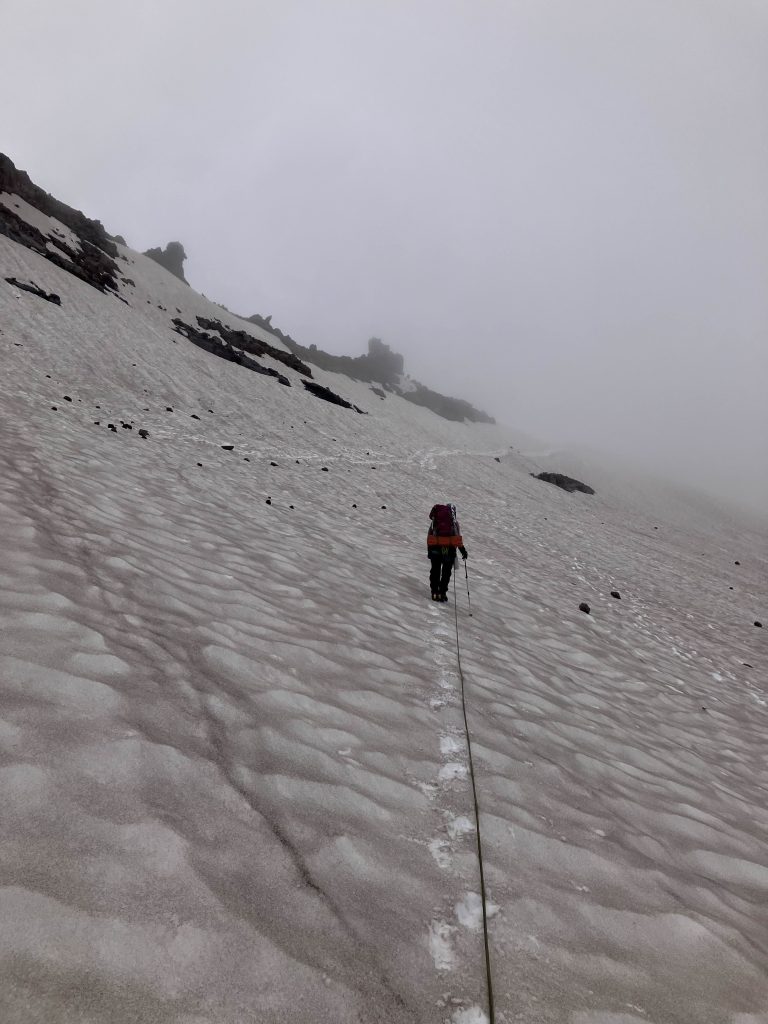
    I had crampons with me, but opted to boot up in just my approach shoes, as putting the crampons on would require putting my ski boots on. I chatted intermittently with the other parties as we made our way along the sloping ridgeline. We reached the 4th class downclimb in the midmorning, perhaps 8 or 9am.

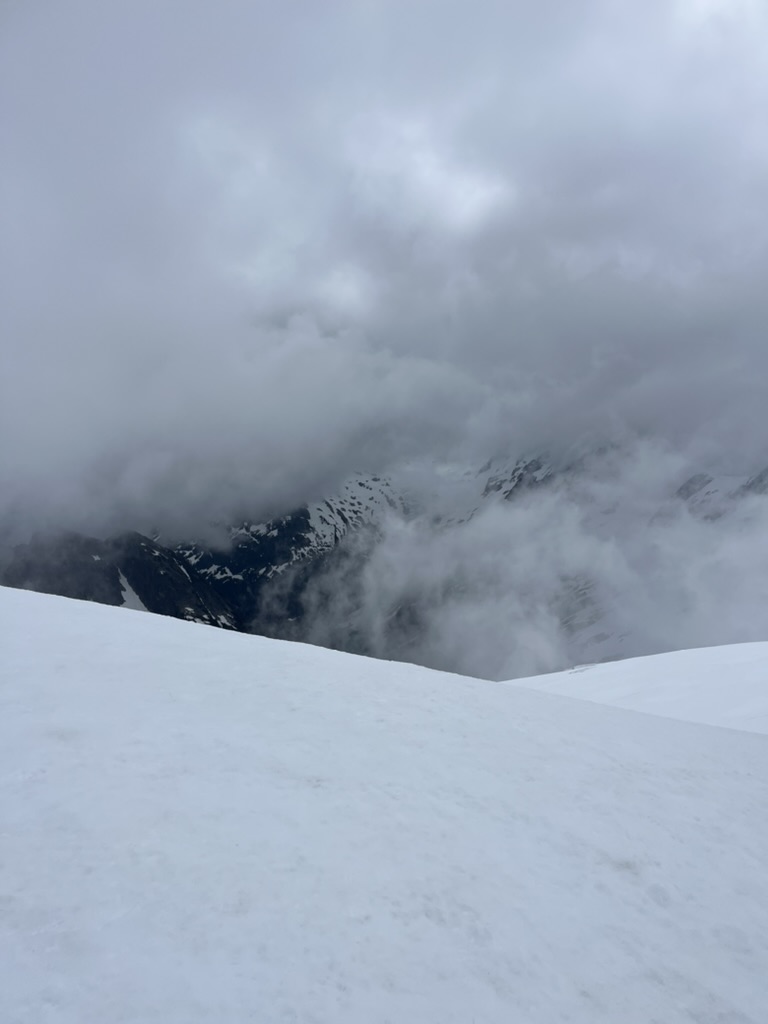
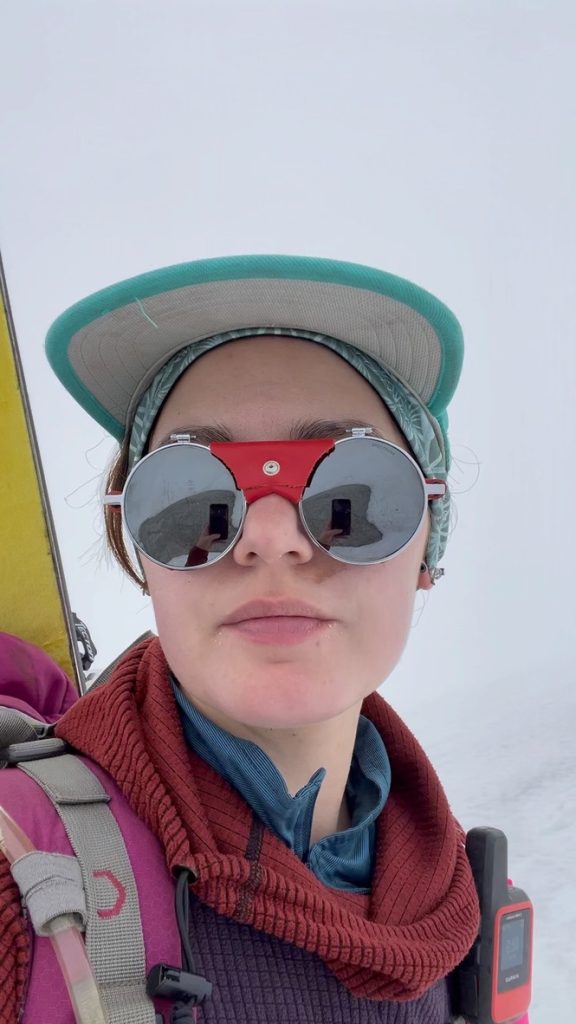
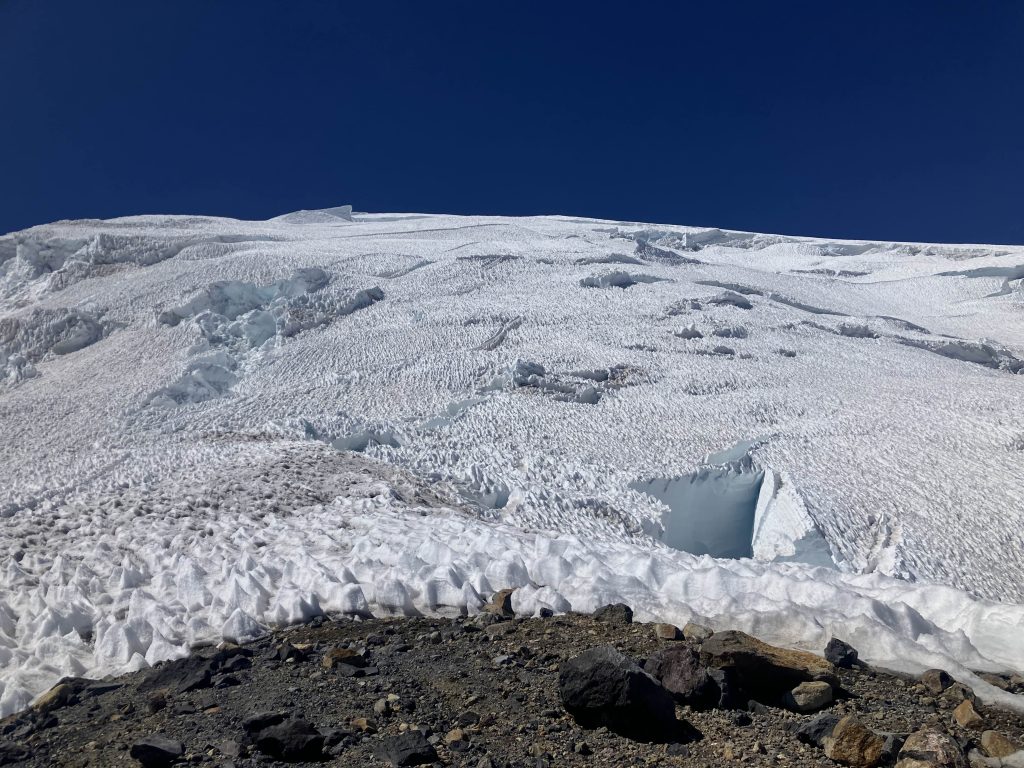
    The downclimb follows a moderate and juggy gulley before emptying out onto a wide, low angle slab. I made quick work of it and continued onto the glacier. The sun had been up for some time at this point, but a thick fog covered the upper part of the mountain. The visibility fluctuated around 50 meters. I could sense the craggy wall of the ridge to my right, but couldn’t see it for much of the section.

    11:00am

    I stopped just behind another party for a break and to transition to skins. I regretfully noted as I was passed by another soloist on skis (wearing jean shorts) that I probably could have transitioned some time earlier.

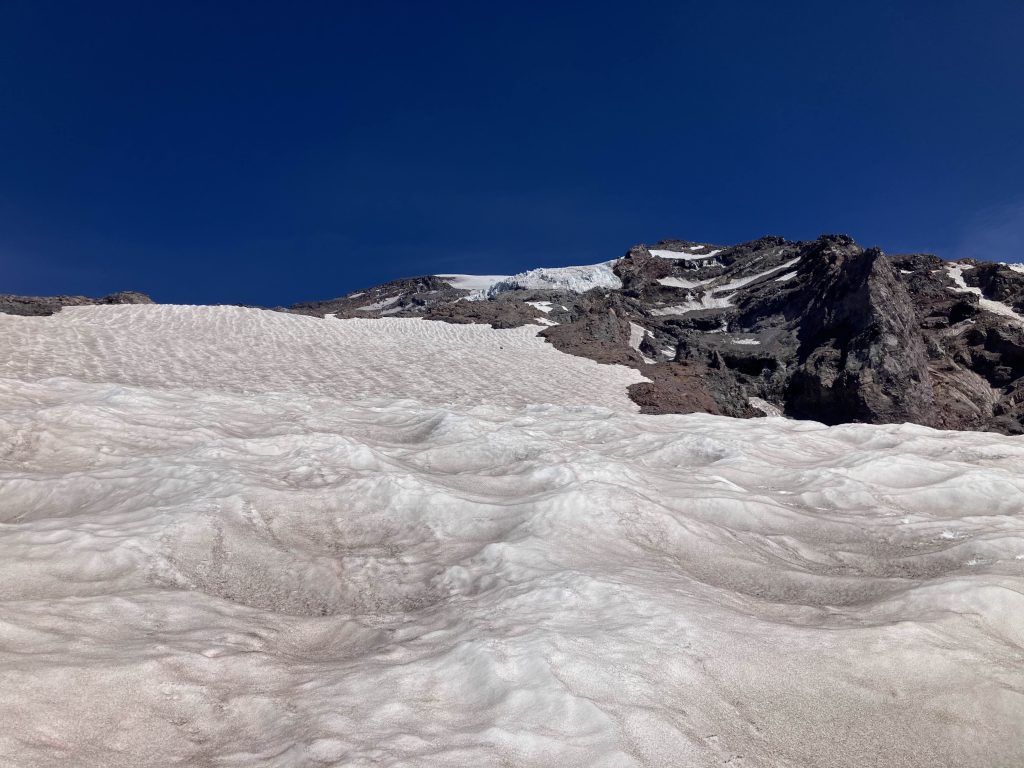
    The skinning from this point went quickly and pleasantly, and the visibility improved marginally as I gained elevation. I reached the flat basin of the Eldorado Glacier at 7500ft around 11:30. While I could see across the basin and even all the way to Moraine Lake in some places, the summit ridge was covered in thick clouds. I gained the ridge and was immediately immersed. Thinking of the cliff to my left and active glacier to my right, I turned around at 7900ft, uncomfortable with traveling solo through the thick clouds with known hazards to both sides.

    12:00pm

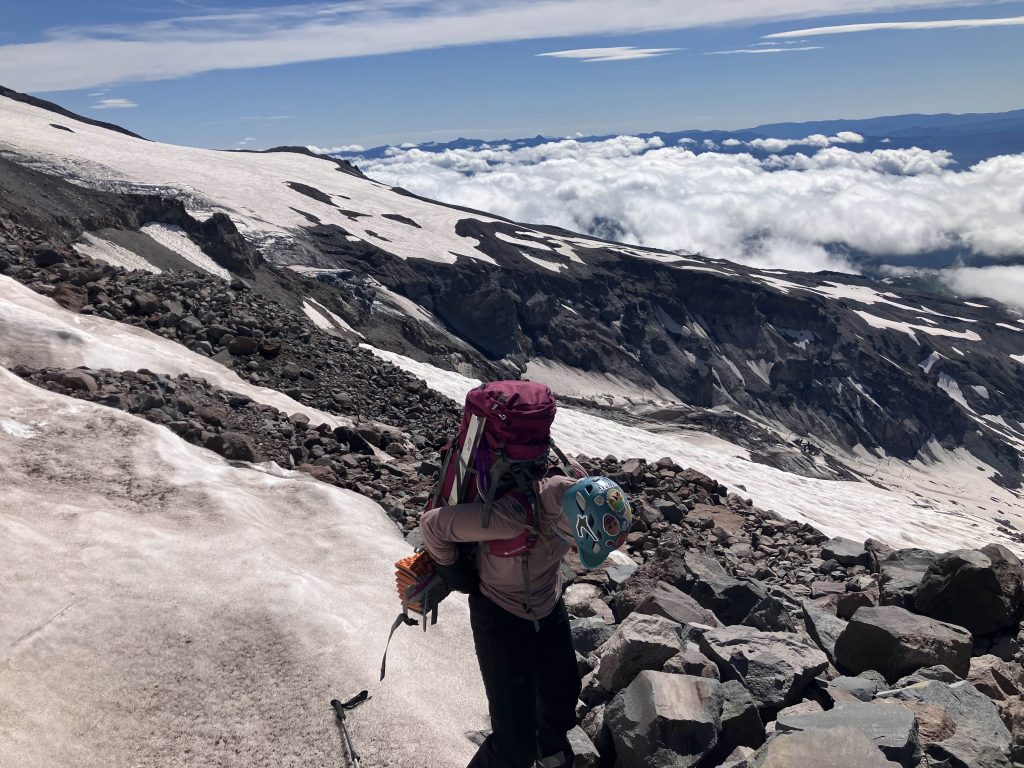
    The snow had been warming slowly throughout the morning, culminating in a glorious ski descent off the ridge. Dropping below the clouds, I bombed it across the Eldorado Glacier, following the obvious compression zone down. It was pure type 1 fun all the way back to the 4th class gulley.

    I decided to keep my ski boots on for the gulley, thinking I would just put my skis back on and ski off the opposite side of the ridge. This was an error. Rigid with smooth plastic bottoms, my boots dry-fired off the slab with every minute movement. I didn’t want to risk sliding all the way back down to the glacier, so I hauled myself ungracefully up the gulley relying on my hands and knees.

    Topping out the ridge, I looked down the 40 degree snow slope on the other side and was met with a roughly thirty person guided mountaineering course grunting and shuffling up the bootpack. I didn’t want to try putting skis on standing on the steep, slick snow and risk toppling a domino chain of beginners, so I opted to keep the ski boots on and plunge step down to the skiers right of the boot pack. However, I had forgotten to remove my ice axe from my pack following my ascent of the gulley. I took exactly two steps down the slope before my ski boots betrayed me again and I was sliding on my back, picking up speed.

    My worst nightmare was becoming a reality in mere seconds. I flipped over onto my belly and tried to dig into the snow with a trekking pole to no avail. Kicking my ski boots into the snow slowed me down, but it wasn’t enough to stop the fall. I was picking up speed and headed straight for a patch of exposed rock. “Here it comes, maybe if I relax my body I can get away with just a broken ankle or something,” I thought to myself. I ragdolled and hit the rocks feet first after sliding around fifty to a hundred feet (it was hard to tell in the moment), bouncing over them and catching a bit of air. My feet landed in a shallow moat below the rocks and I hinged at the hip, jack-knifing into the snow below and smacking my helmet. I sank into the moat, just in front of one of guided parties.

    Immediately, one of the guides rushed towards me and helped me take my pack off. I did a quick body inventory. Nothing felt broken or numb. I was shocked and shaking, but still alert. The guide asked if I was alone, to which I replied yes. He then asked if I had an SOS device, which I did. Seeing as I was unharmed, he wished me a safe descent and encouraged his group to take their ice axes out and keep moving. I chose to stay where I was for a few minutes, letting the rest of the guided group walk around me.

    Many people in the group felt the need to come talk to me while I rested and let the adrenaline dissipate. Most of them just asked if I was ok, but a handful wanted to make sure I was acutely aware that they thought I was stupid, reckless, and undeserving of their respect. I didn’t have any response for them. One woman seemed particularly unsatisfied by this. She emphasized at least twice that when she left, I would be alone. I insisted that I was well aware of this, and that I wanted to be alone. I was just grateful that this was a near miss and not a developing rescue situation.

    With no choice but to continue downward, I skied the rest of the snowfield like I intended. The remaining on-foot descent was a long, exhausting trek. My stoke had all but completely disappeared after my sliding fall. My skis scraped along a mile of boulder field (now I understand the kvetching). Some younger lads also skiing down had heard tales of my unfortunate fate from the guided party and offered me some jelly beans as consolation. I think that was the most helpful response I encountered. I reached the car in the early evening, around 6pm.

    Reflection

    The sliding fall I experienced was due to two specific complacent decisions: I was lazy and didn’t take my ski boots off when I would have found it easier to move in my approach shoes (as I found during the 4th class gulley as well), and I didn’t take my ice axe out when descending the snow slope. This can be extended to a meager analysis of the fall consequences. I didn’t examine the runout of a potential fall, because I was wrongly convinced I wouldn’t fall. In general, I didn’t treat the terrain with enough respect and suffered the consequences. I’m grateful that I wasn’t more seriously hurt by those decisions.

    How my behavior can change to protect my safety:

    From now on, I can assess potential falls for every section of ascent or descent (not just particularly intimidating ones) and classify them by no-fall or yes-fall based on the slope angle, runout, snow conditions, and whether it’s possible to arrest a fall at all. This allows me to gather real, observable information about the consequences of a fall, and might have influenced my decision to get my ice axe out, change my shoes, or find a different route.

    I also plan to treat transition opportunities with extreme caution. By not taking my ski boots off out of laziness, I accrued more risk than I was ok with. Any opportunity to transition (e.g. before the 4th class gulley, at the top of the ridge) deserves a proper assessment about what tools are needed for the job. This can be combined with fall consequence assessment. Having a set protocol for evaluating a transition point, for instance looking at the distance, angle, and obstacles below the ridge and then deciding what tools I needed instead of making emotional or ego-driven decisions about the transition would have allowed for a more intentional acquisition of risk.

    Getting complacent is normal human behavior and we all do it. I am a human, so I will certainly become complacent again. The way I want to protect myself from this is by defining a protocol based on observable parts of my environment and re-training it often.

    People have had lots of comments for me about the fact that I was soloing when this near miss occurred. All things considered, I still think the decision for me to be solo was appropriate. I had all of the skills and gear necessary to solo that terrain. I’m confident in my route finding skills on glaciers and rock up to 4th and low 5th class. I’m a proficient backcountry skier. I had all the tools with me to do the entire ascent and descent safely, accruing only the risk I was ok with. My near miss didn’t happen because I was soloing, it happened because I didn’t respond to the risk associated with that section intentionally.

    On the topic of soloing:

    I also want to point out that climbing with a team doesn’t ensure your safety beyond the skills and capabilities of that team. It is my responsibility as a climber to accrue risk appropriately for me, and I will never passively outsource my safety to other people on my team. I have a theory that people expect women in the mountains to shy away from taking the lead on hard decisions, let alone climb solo. Ultimately, the only person who decides if the climb is appropriate for me is me, regardless of what other people expect of me.

    Overall review!

    On a lighter note, Eldorado peak is a fantastic climb. It has a distinctly Cascadian wildness that sets it apart from a more well-traveled Mt. Baker or Mt. Rainier. Despite the inconvenience of bushwacking into stinging pits of stinging nettle and scraping your gear over a mile of boulder field, it makes you feel for a brief moment like you’re Fred Beckey questing into an unknown alpine. Except you get a parking lot at the end.

    While unfortunately the low visibility kept me off the knife edge summit ridge, I look forward to coming back and seeing Eldorado in her full glory sometime. I certainly got what I came for, which was a gorgeous and transformative day in the alpine. You’re going to love it.

    -M
  • Indian Creek

    Day 1

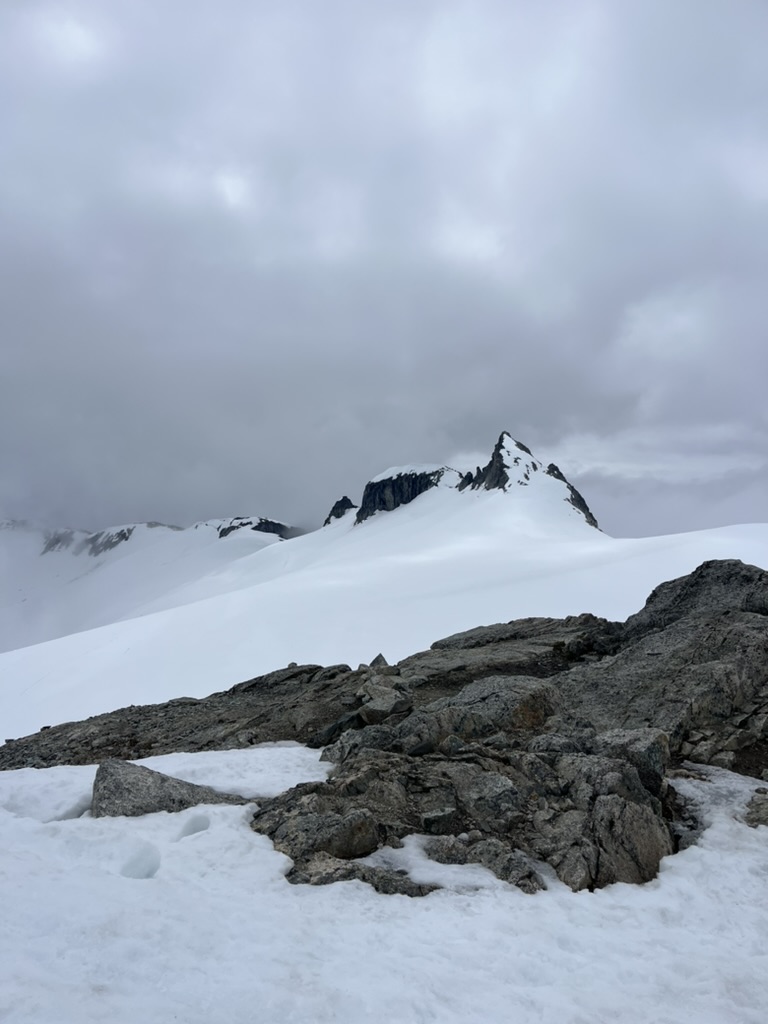
    Aiden and I arrived in the Indian Creek climbing area (about an hour south of Moab, UT) Tuesday morning on March 24th. While it was Aiden’s first time climbing in the creek, I had some adjacent experience at Mary Eden’s crack camp in September of 2025. This marked my first return.

    Our only goal for day 1 was for Aiden to aid up some 5.11’s on the shorter side and we would take turns lapping the climbs on top tope. Our first wall was Power Wall, our first climb was called Power Play, a beautiful 0.75s crack with a miniature roof pull and a couple sections of aptly named powerful laybacking. The session felt contemplative and quiet for the first half, with just the two of us there. I resolved myself to the reality that I wouldn’t be leading much of anything in the creek, and that it might be a better use of my time just to focus on perfecting my crack technique on the long pitches. We were joined in the early afternoon by a good-natured party from Spain who proceeded to crush the routes surrounding the one we had set up. They worked their way methodically towards our route and then eventually retrieved our anchor for us. We chatted amicably for a while before the sun encroached and we headed back to town for a swim in a local river access area and to replenish our supplies.

    Day 2

    An acquaintance from my graduate program, Sam, had told me a week or so prior that she was also climbing in Moab over spring break. We made loose plans to meet up at Trick or Treat wall. We got a later start on day 2 and made breakfast in the parking area, scoping out the abundance of sunny canyon crags. We struck up a conversation with another climber doing the same thing, who introduced himself as James, and discovered that he was waiting for the same party. We ended up hiking in with a large group of 8 or so. Trick or Treat is shady all day, so we camped out at the base of the first wall we saw and the strongest of the group began putting up ropes. I belayed Aiden on a rather harrowing 5.10 with a brief section of 4’s offwidth. The rest of the day was spent trading top-rope laps on any climbs available and making new friends.

    Indian Creek has a unique climbing culture and barter economy. People are willing to share pretty much everything – ropes, snacks, and gear. There’s some unique bits of climbing language (e.g. I’ve never heard someone describe a cool route as “nails” before). Dirtbagging of any capacity is encouraged, and it’s particularly common to show up to the crag alone and simply join a large group so long as you can contribute something for the good of the party, typically putting up a rope for others by leading or aiding. The creek beats people up. The pitches are long and if you aren’t leading them you at least ought to be climbing as many of them as possible. Giving up isn’t an option. By birthday belay or jugging or grunting and twisting everyone makes their way from the bottom to the top. Long-time creek climbers are industrious and determined and seem to have no fear of heights. The pitches often require the full extent of a 70 or 80 meter rope.

    I found myself particularly entranced talking to one such long-time creek climber, Diana. A professional rock climbing guide and experienced dirtbag, Diana told stories of making her way to China with nothing but a printed map. She talked about some of the different things she’d done to make money on the side, and the people she knows in the climbing “lifer” (another word I learned, more on this later) world. She had an easy, confident strength that was obvious in her climbing, and I’ll never forget watching her lead a monstrously long handcrack with continuous ease. She didn’t seem particularly impressed or phased by anyone or anything there, periodically offering sagely desert-rat climber advice throughout the day to anyone who asked. It was a delight to witness.

    I climbed everything I could. I finished all the pitches, some of them more gracefully than others, but I was proud to have done it all on my own power. During crack camp, I relied significantly on the customary birthday belay to learn the technique step-by-step. This time though, I felt stronger. My climbing was more continuous, and I could even imagine myself placing pieces from some of the stances. My endurance would falter though, and roughly every 10-20ft I would run out of steam, lose the technique, and slip out of the crack. I found the same pattern almost independent of size, from finger cracks to 4’s, except for a couple of particularly challenging sections. While I was seeing notable progress, I still felt overwhelmed by the scope of what I still wanted to accomplish. I channeled my existential worry into pure output, hopping on every rope as soon as it was offered to me. I climbed until my tape gloves disintegrated and my hands were red and raw. We left that evening and I was an all-consuming tired, the kind that seeps into your bones.

    Day 3

    The late starts got even later, as we made it all the way into town to replenish supplies and water and back into the creek before we ran into the rest of our newfound party, led by Rosa, another rock climbing guide. Beat down from the first two days, we hiked slowly through the sun towards Habitado, which was amazingly still shaded when we got there. Aiden aided up a heinous flaring 0.75s crack and we took turns flailing on it until the sun emerged and started to roast our hiding spot.

    With much deliberation about what to do next, no decision was reached. Despite his declaration of taking a rest day, James showed up to join us (with only a harness and a couple of Modelos, incase an extra belay was needed). No decisions were reached then, either.

    We waited in the meager shade of a nearby tree until Aiden and Sam set off for a sport climb we passed on the way in, a 6-bolt 5.10a oddity meandering up a bunch of huecos. Aiden onsighted it, as did Sam, and I was offered another top rope. I accepted, but the tape on my hands and the baking sun resulted in me immediately sliding off the first sloper and a sickening wave of heat exhaustion. I bailed. It was my only unfinished pitch of the trip. I lay down between some rocks, shimmying into what remained of the shade and proceeded to feel sorry for myself.

    Thankfully, I was not making decisions for the group, because with the determination of true creek climbers the rest of our party scoured the guidebooks for anything shady. As the sun retreated over the canyon walls, we found ourselves at Chocolate Corner, a 5.9+ classic with splitter 1’s in a 30 degree or so corner. It gets its name from the dark reddish brown rock which looks remarkably like melted Hershey’s dark. This was Aiden’s show. He led the route with one take and vowed to return for the redpoint. Rosa top-roped, and I realized that I had one more chance to get everything I could out of this day. Maybe I too could harness the determination of the quintessential creek climber. So I tied in and gave it a shot.

    Chocolate corner is a classic for a reason. 1’s are perfect hand jams for me, and I found a delightful flow state twisting my hands and feet into the bottom section of the crack. As usual, I ran out of steam around the halfway mark and had to take a break, but I returned for the send with only 2 more takes. I lowered and untied, and my raw skin seemed to validate that I was done for the time being. I gave the creek everything I had to give.

    I did have the privilege to witness (and belay) Aiden’s redpoint, the final climb of our Indian Creek venture. In the midst of the chaos at the base, he took two deep breaths before launching into a smooth, continuous string of jams. He placed gear at longer intervals than usual, opting for efficient movement over the warm fuzzies of an extra cam. Reaching the anchor, he let out a whoop. What a victory! I was so glad to see him enjoying himself, reaching that ever so sought after state of concentration and joy. I saw him fall in love with the desert in that moment.

    Reflection

    I got beat up by the creek in a different way than my first time here. The distinct lack of moderates ensured that I didn’t feel confident enough to get on lead, which is in turn coupled with feelings of guilt and frustration. I wondered several times if I should just decide to push through and get on something, but I talked myself out of it each time. I wasn’t feeling well enough, someone else was doing it already, etc. It’s clear that if I want to progress through this stage, something has to change.

    We listened to a couple of Enormocast interviews on the car ride home, riding the stoke back to Seattle. I thought about talking to Diana, and the pro climbers I was listening to. Do I have what it takes to be a “lifer?” My climbing history and progression hasn’t been anything special. I’ve been on-and-off with the sport for a long time, and in that time I never really progressed beyond 5.8’s and 5.9’s. I don’t have the natural talent that some people have to carry them through the moderates. I didn’t really care to progress. But when I started mountaineering, I found the joy that everyone talks about. If I don’t see a glacier for too long I think I start to feel a little crazy. I want desperately to give myself to the mountains, to try as hard as I can to keep moving, keep climbing. It’s a special thing to start a trip and know nothing about what awaits you except that you will be changed by it.

    I came back to rock climbing this time, because I have unfinished business with it. Like Aiden and his redpoint. That joy and passion is in there, in the form of some fundamental truth about myself. I want to excavate it and create something new. I want the creek to finish beating me up.

    I set a goal in January to climb 5.10 trad this season. Maybe I have what it takes to achieve my wildest climbing dreams, maybe I don’t. But before then I will need to reach that goal. I went on this trip to enter the crucible, to experience becoming. And here I stand, changed at the end of it.

  • Kautz Glacier

    Day 1: Saturday, July 26

    Aiden and I reached the Paradise parking lot at MRNP at 7:30AM and were on trail around 8:30. We enjoyed a brief walk on the beginning of the skyline trail and chatting with passerby before ducking some lines (Ranger approved) and taking a climbers trail down some loose scree to the lower Nisqually glacier. Gaining the Nisqually glacier this late in the season required some surprisingly time-consuming moraine scrambling on loose, fist to watermelon sized talus. We hopped 2-3 moraines before we were roped up and consistently walking on ice and snow. There were few crevasses and the glacier was quite flat at this part, but quite a bit of rock and icefall hazard. We saw some rockfall on the cliffs to the climbers right, and heard much more. There were intermittent periods of cloudiness in the valley, which would not boil off until mid-afternoon.

    We climbed the Nisqually until reaching the Wilson bench around midday. This was good snow and relatively free from overhead hazard until passing underneath a large rocky outcropping below the ridge crest. We ascended to one such section of exposed rock and scrambled across 20-30 feet of awkward, wet class 3 slabs before continuing up to the ridge crest. This was a long continuous push due to the rockfall hazard of being below the ridge. From here it was uncomplicated but tiring scree and steep sun cup walking up the ridge to upper castle. Somewhere around Sharkfin camp we climbed fully out of the clouds, getting our first good look at the enormous task ahead of us. We reached Upper Castle (9,400ft) around 5pm and set up camp. A party of two passed us to camp at Hazard, and we saw another party of two camped below us at Lower Castle. The plan was to sleep for as long as we could before climbing the remaining 2000ft to camp Hazard (~11,200).

    Gaining the ridge to Castle

    Day 2: Sunday, July 27

    We packed up and left Upper Castle at 10:30 the next morning after a long rest and a leisurely start to the day. It was warm and toasty in the tent and sunny and windy outside with temps in the 50s during the day. Gusts might’ve been as high as 10-15mph on the ridge the night before, but for the most part we were sheltered from the wind and conditions were good climbing the Turtle Snowfield. This was an arduous walk up sun-cupped 30-40 degree snow. The snow surface was soft and slushy with a hard layer of consolidated slippery snow underneath. We climbed through midday, reaching Camp Hazard at 2PM. Camp Hazard is just below the rock step that marks the beginning of the Kautz route and is potentially compromised by large seracs and rockfall high above. It’s exposed and windy. Hesitant to overstay our welcome, we planned to nap here until 5pm and make a bid on the ice chutes in the early evening to do the technical crux in the remaining daylight. This would put us on the upper Kautz during the coldest part of the night, when snow bridges would be the most stable.

    At the base of the Turtle snowfield
    Looking up the Turtle snowfield

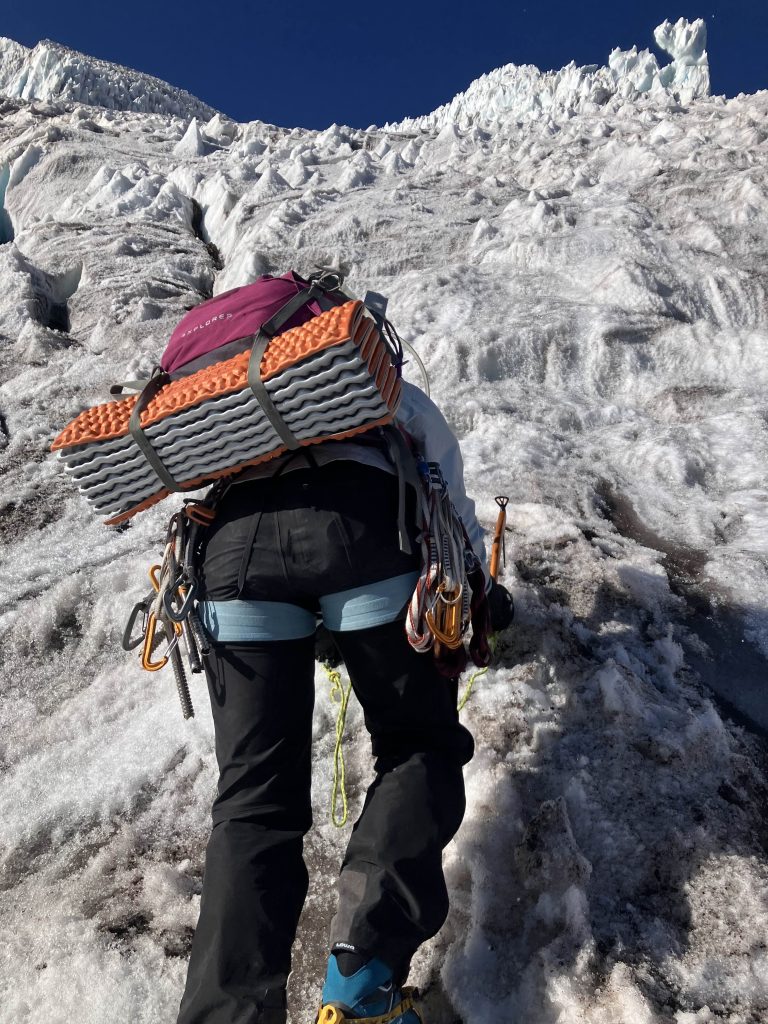
    After resting and fueling up as best we could (the altitude was starting to get to me at nearly 11,300ft) we descended the rock step in an awkward half-belay half-downclimb process. My panic attack tendency reared its ugly head trying to scramble across the rockfall zone and onto the Kautz to the base of the route, nearly causing us to turn around, but I took some deep breaths and with some encouragement from Aiden we reached the base of the climb unscathed and calm. The Kautz is separated into two distinct ice slopes with a lower-angle snowfield in between. The ice was relatively bare and hard, with running water trickling down the center. The first ice slope varied in pitch from 45 to 60 degrees in chunky ledges for a general grade of AI2-. I led the first section in one 70m pitch followed by another 40m or so of steeper ice into the easy simul-terrain of the middle snowfield. The ice was in prime condition, an inch or two thick layer of crusty alpine ice over plastic, blue glacier. The sticks were good, and the screw placements (we took eight ice screws) were better. Climbing through the first slope was smooth and comfortable, albeit a little gripping to look down and see the massive ice cliffs below and the seracs above and to the climbers right. Not bad for my first ice leads ever! I placed a picket and microtraxion where the grade eased off into the snowfield and we simuled to the base of the crux.

    Starting the first ice pitch

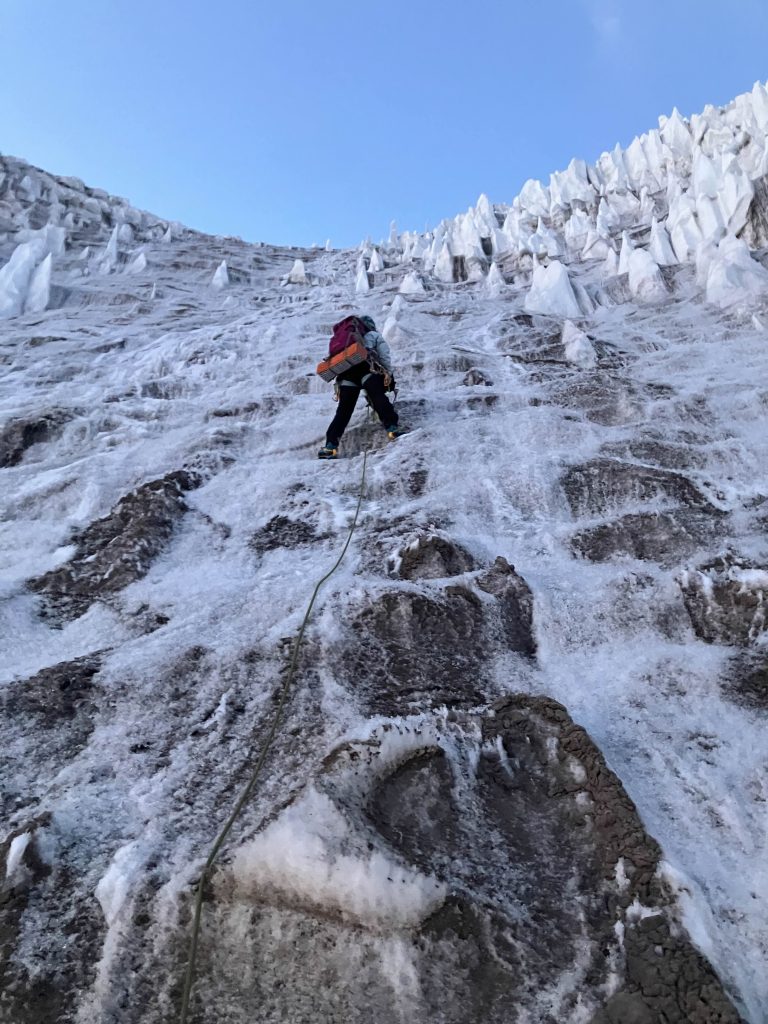
    It was starting to get dark in the chute as the sun went over the ridge to the climbers left, so we decided to shorten our pitches such that we could easily stay in communication. I set off up the first pitch of the crux, which was slightly steeper than the first chute: a sustained 60-65 degree slope with smaller and fewer chunky ledges. I built an anchor 35m above the belay at a huge penitente. Despite the slightly headier moves, the ice was even better on the crux making for smooth, enjoyable climbing. I was getting tired though, so we decided to change leads here. Aiden was feeling good and more than happy to get some leads in on the crux.

    Darkness encroaching over the ridge
    First pitch of the crux

    We climbed two more pitches of similar 65ish degree ice up and out of the crux, and then another pitch where the grade slowly eased off above the chute. The smooth, rolling ledges of alpine ice gradually sharpened into penitentes as the grade decreased. By this point it was completely dark and getting to be a brittle, biting cold in the low 20 degree range. After the fourth pitch we transitioned to roped glacier travel for the upper Kautz with Aiden leading. This turned out to be fighting through knee-to-waist high penitentes. We trended to the right, encountering larger and larger crevasses along the way. Had it been light, we would have been able to see a rather obvious path up the left side of the Kautz avoiding the largest of the crevasses, but instead we found ourselves crossing a couple dubious snow bridges. One of these was only a few feet wide and overhanging on one side, though eight or ten feet deep and stable, requiring an acrobatic shimmy across. Aiden scrambled across without any issues, but after the mental toll of the ice chute and the disconcerting blanket of darkness above (and now below) me I felt the effects of my panic attacks once again. I attempted to mount the snow bridge and promptly freaked the fuck out. Aiden set up a belay and I tried again, slowly but surely inching my way across. In hindsight, we could have handled this a lot better. For one, our route finding in the dark took us through an objectively suspicious part of the Kautz, when we should have opted for more walking across a safer part of the glacier. Secondly, I didn’t ask enough questions about this snowbridge crossing – I assumed Aiden wouldn’t be able to come back across, and that our only option was for me to buck up and figure out a way to do a snow bridge cross I was obviously uncomfortable with, when in reality he could have come back easily and we could have looked for a better place to cross. Instead I made a knee-jerk assumption and then put myself in an objectively worse mental state in an already risky situation, damaging our communication. This was the last of my “panic” moments for the route, but unfortunately not the last of our dubious snow bridge crossings.

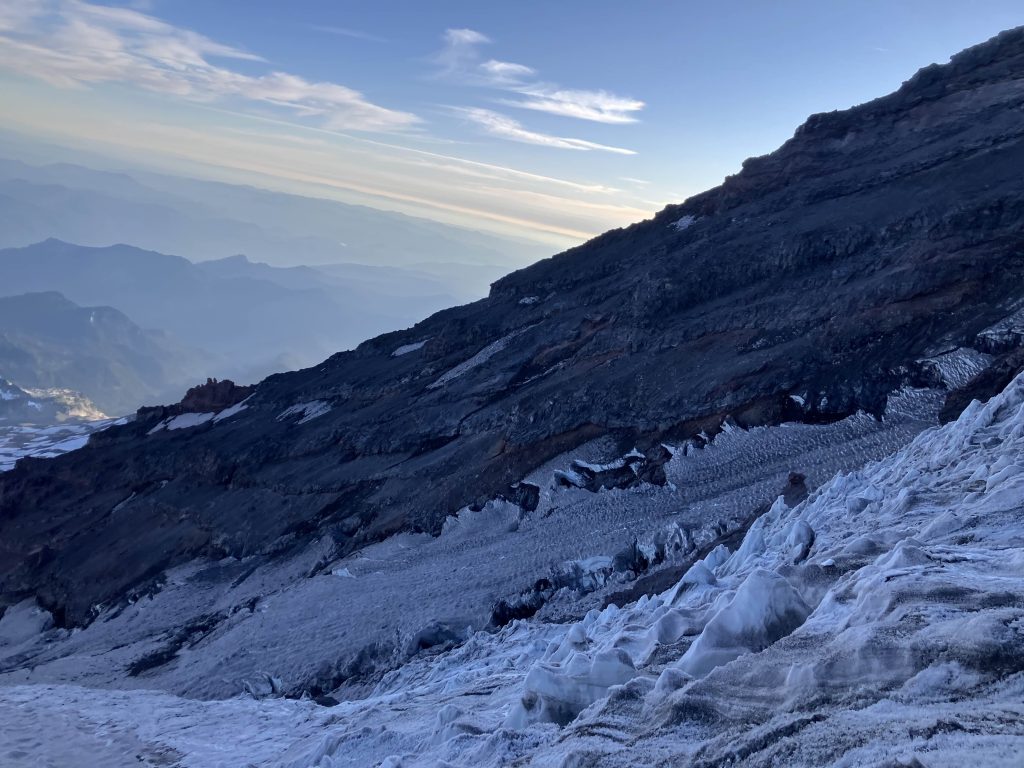
    We continued to weave through penitentes, now slowly but surely aiming towards the top of the Wapowety Cleaver. It was bitterly cold at this point. Our water was freezing and the going was slow. Penitentes made for difficult movement and obscured complex intersecting crevasses. At one point I even broke through an ice bridge up to my hip, warranting a yelp of surprise. Luckily the crack was small and I was able to wiggle my way out without issue. We crossed the Wapowety Cleaver at 13,000ft in an attempt to gain the upper Nisqually glacier and make a break for the summit, but Aiden shortly discovered a house-swallower crevasse with no end in sight. We were dead-ended, freezing cold and uncomfortable with the prospect of wandering around the upper Nisqually in the dark. We set up an emergency bivvy in a sheltered spot on the Nisqually side of the cleaver at 3:20AM with the intention of hunkering down until we had enough daylight to continue.

    Day 3: Monday, July 28th

    Three hours of the coldest sleep of my life later, we were up and moving again at 6:30AM. We walked a short ways down the Wapowety Cleaver, discovering some intended bivvy sites (if only we knew!) and then once again out onto the Nisqually. A criss crossing of house-swallowers appeared to be the last big obstacle before the last penitente covered slog to the summit. Inspecting the crevasses, I found a point with a big but awkwardly pyramid-shaped snowbridge. I remember saying to Aiden “it’s gonna be scuffed, but it’ll go.” I scrambled across without issue, but I was uncomfortably aware that the peculiar shape of the bridge made it difficult to tell which parts were well supported by the ice underneath it.

    Once again in hindsight, it’s easy to see that we have become a little too comfortable with snow bridges. I’ve never taken a big fall into a crevasse, nor have I seen any larger structures collapse in person, besides hearing a serac fall from the other side of the mountain on Kulshan. Examining snow bridges carefully and setting up belays certainly helps mitigate some risk, but even with a belay the consequences of a partial or full bridge collapse or fall in this situation would have certainly meant injury and could possibly be fatal. There were enough unknowns here (how stable is this bridge actually and which parts are the most stable, when would it collapse, how would it collapse) that I don’t want to include this kind of exposure regularly into my risk tolerance. I’m glad that nothing notable happened. It won’t be a habit from here on out.

    Luckily for us, this was indeed the greatest of our remaining worries. It was shaping up to be a beautiful, cloudless day. The remaining walking up to the summit was an uneventful slog through the never-ending penitentes, with some end running of a few large crevasses and another couple of snow bridges which were thankfully uncomplicated. We reached the summit at 11:30AM. I don’t think I’ve ever been that tired in my life, and we still had all the way down to go.

    Finally at the summit!

    We took the DC route down. It’s beautiful, and really has anything a beginner mountaineer (or anyone looking for something less involved that what we just did) could want. Beautiful views, a handful of ladders across yawning crevasses, and a bit of easy scrambling on the cleaver. I enjoyed myself coming down in spite of my body feeling like it was going to collapse. We moved quickly through the icebox, high crack and bowling alley, and finally relaxed once we reached Camp Muir. By the way, I think Camp Muir is possibly the best place to be if you want to talk to someone who understands what the hell you’ve just been through after fighting for your life on the Kautz. Arriving beaten down mentally and physically, we were greeted by friendly climbers who refilled our water and asked us about the trials and tribulations of our quest. We discussed the conditions on the DC route and how good it was going to feel to be home. Also I forgot my water bottle at Camp Muir, so on the off chance anyone reads this and finds it, it’s a green and pink Owala. Please send me an email or something! I love that thing and miss it already.

    Looking up at the DC route from the top of the cleaver

    The Muir snowfield was a surprisingly fun descent, with sections of slippery plunge stepping and glissading. It felt like we were only walking for a short time before we were back on the Skyline trail down from Panorama Point. I told Aiden later that this section felt like the longest and hardest part of the descent, despite objectively being the easiest and shortest. My feet hurt so badly walking on the trail after wearing mountaineering boots for 26hrs that I was in tears. I was counting my steps by the 100s to get down to the parking lot. We made it back to Seattle around midnight, just in time for a stop at Dick’s Drive in before collapsing at home. What a day.

    Debrief

    Technical Gear Brought:

    • 70m rope
    • 8 ice screws
    • v-thread tool
    • single and double length slings for anchors
    • glacier travel kit (lockers, tibloc, prussik cord)
    • 2 microtraxions
    • 2 pickets
    • 2 ice tools per person

    Mistakes:

    • Getting too comfortable with sketchy snow bridge crossings
    • Shaky communication when crossing snow bridges
    • Underestimating the time and commitment of the approach

    Victories:

    • Great selection of rope techniques and transitioning between them!
    • We summited!
    • Decision making during the crux and on the glaciers was solid: choosing to bivvy when we did, when to move fast to avoid overhead hazard, when to set up belays.

    Other Comments:

    • Hot take, I’m glad we started the crux pitches in the evening despite the issues we had with the cold on the upper Kautz. The ice was the perfect temperature and it felt good to have some light for the ascent. I think this plan worked out well for us being beginner ice climbers and therefore on the slower end – in the future I would want to have the fitness and experience to climb the Kautz in two long days starting the ice pitches in the early morning.
    • Climbing never really got harder than AI2+, but in the late season this is all solid ice without a lot of snow and it absolutely eats screws. The rangers told us that recent parties were calling it AI3 and personally I think this is a bit of an overstatement. Since the climbing is so sustained and has little snow on it it’s a bit heady and needs to be taken seriously, but the movement is straightforward and pretty low-angle with lots of big hands-free ledges for placing pro and building anchors. I’d call it AI2 with a side of good old fashioned fun.
    • For conditions similar to ours, I would want at 6 screws minimum, perhaps up to 10. The party of two that passed us on Day 1 turned around because they only had a 30m rope and had planned to simul a great deal of the route. We were comfortable pitching things out in full rope lengths with our 70m rope and 8 ice screws. The party of two behind us had a 50m rope and 6 screws and passed us right around the time we started moving post-bivvy.
    • The approach to this climb in the late season is complicated and annoying with moraine crossings and lots of bare glacier. I imagine it’s a lot more straightforward in the early season, and the climbing is most likely easier as well on the crux pitches with some more snow and ice. If the prospect of sustained AI2 on solid ice is a little too freaky, I might opt for an ascent in May or June instead.
    Photo credits to Aiden, my favoritest climbing (and life) partner! My phone basically instantly died from the cold but I managed to get this one 🙂

    Man, between this trip and North Ridge I think I might have a newfound love in ice climbing. That being said I wouldn’t mind a long break from 20+ hour pushes. Kautz is a great route. In the late season it’s tough, committing and starkly beautiful with some great alpine ice. You’re going to love it.

    -M
  • Kulshan North Ridge

    Day 1: Sunday, July 6th.

    Having just returned to Seattle after visiting my family in the midwest for July 4th, Aiden and I planned for a late start on the north ridge. Day 1 would consist solely of the climb up to the Hogsback camp from the Heliotrope Ridge Trail. We packed bags and started the 2hr30min drive to the trailhead at 11am. Between lunch stops and a trailhead rendezvous with our third party member Eli, we were on trail at 3:30pm. We reached Hogsback camp at 5:30pm.

    There are two notable creek crossings on the Heliotrope Ridge Trail. The creeks were relatively low when we crossed, but the “big creek” about 2000ft of vert from the trailhead has a large waterfall below it so I ended up with wet feet from shuffling securely across. The second creek was low enough for an easy cross via rock hopping. No snow on the trail until camp, as would make sense given this point in the season.

    We shared camp with two other parties. One set of two tents (2-4 people?) who must have been asleep when we got there because we did not see them at all, and a group of six tents in a guided group. We didn’t speak directly to anyone from either party but speculated that the guided group was there for the Coleman-Deming route or potentially a crevasse rescue course. It was kind of surprising to me how few people were at camp, given the cloud-free warm weather that day and the following day.

    Day 2: Monday, July 7th.

    Summit day began with an alpine start at 2:25am. We roped up and put crampons on pretty much immediately, as there was a large moat ~200ft above camp we noted the night before and the high route to avoid it would make finding a convenient place to transition to roped travel somewhat difficult. We stayed on the C-D route to gain the first ridge above the moat, and then split off towards the eastern Coleman glacier.

    The next mile and a half was spent traversing the Coleman. This began with uneventful flat fields of ice and easy cramponing, but the yawning crevasses in the distance eventually approached and we found ourselves snaking through a maze of fridge to automobile sized cracks. This culminated in one particularly spicy crevasse crossing with a snow bridge which, despite being eight feet deep and comfortingly solid, was only two feet wide. With careful steps, we continued upwards towards the base of the ridge.

    We took our first break at sunrise on the rocky outcropping that marks the base of the north ridge at around ~2380m. Another party caught up to us here, three people doing a single-day push. The next few hundred feet was a ~45 degree snow/ice slope up to another rocky outcropping, followed by another hundred feet of 40 degree snice. We short-roped this section, but later lamented the lack of protection – a fall here would have meant tumbling over the rocky cliff we took our break on. The snice gave way to a flatter section at 2580m, where the other party passed us (for real this time) at 8:15am. From this section we could see the crux pitch, a steep blue headwall.

    Another longer break here for some food (and a bathroom break) and we began what would be a deceptively long trek up the wide ramp to the base of the crux. This started as easy but tiring snow climbing and then quickly transitioned to more consequential snice. I was leading the rope team. We started with the full seven armlengths between people in the lower part of the ramp and then transitioned to our short-roping configuration from earlier.

    We followed the tracks of the earlier party around a large crevasse, where the snice steepens to 40-50 degrees. At this point, said party had reached the crux pitch and proceeded to fling gratuitous amounts of ice down onto us. Unprotected, we traversed quickly to the left to the only shelter we could find, a moat underneath a small section of exposed rock. We placed a picket here, and Eli claimed the first leads of the day. We had a 70m rope with Eli tied in at the midpoint and the two followers at the ends for 35m pitches. This was unfortunately not a good move – everything seemed to look closer than it was, and it took us four 35m pitches to reach the base of the crux, eating up precious time. We had only two pickets, so protection was minimal: mostly just one anchor to another. We reached the base of the crux at 12:30pm, cold and bickering. Somewhere in this time frame there was an enormous thundering, which I predicted (and I was right) was an unstable serac falling off Colfax peak onto the Coleman-Deming route that I had seen the previous weekend climbing C-D with some other friends. So far as we know, no parties were hurt.

    Eli was exhausted from the numerous snice leads getting up to the crux, so Aiden took the crux pitch: a solid AI3 ramp curving to the left over a dip in the headwall and then straight up the 60 degree ice above. We made a fatal mistake here in that we only had six ice screws, one of which was incredibly dull. In an effort to quickly protect the crux, Aiden switched the dull screw for our brand-new and sharper 22cm screw, which we brought for making v-threads. He continued to climb, hoping to place a picket in softer snow above, and instead was met with more ice with only the dull screw for anchor building.

    Back at the belay station, our radio promptly died. Go figure. We waited in the meltwater coming off the headwall, slowly getting colder and wetter. After 15 minutes passed, Eli and I tried yelling to Aiden. No response. We yelled louder. No response. We waited for another 15 minutes, getting grumpy. By the time 50 minutes had passed, we were both shaking and had fully numb hands and feet. We wondered if something bad had happened to Aiden. We devised a plan to have Eli lead up the first crux section and try to communicate with him, and prepared for the possibility of a SAR call. Just as I had Eli on belay, Aiden started to pull the slack out. We were free! Cresting the headwall and seeing Aiden sitting at the belay gave me an intense feeling of relief. Approaching the anchor, I saw that he had painstakingly bored two v-threads with the short dull screw and equalized them. He was worried that one wasn’t enough with the reduced screw length (and no other screws for a screw anchor). We laughed and then cried, and then laughed again.

    Despite the welcome reunion, our work was far from over. To keep things simple, Aiden led another two pitches up 60 and 50 degree ice after the crux to our final obstacle, the bergschrund at ~3200m. We cut left here to avoid the gaping glacial abyss and up a funny looking 50 degree ice slope onto the flat plains of the summit. Aiden placed a picket and microtraxion at the top of this step for running protection. From here, it was a calm trudge to the summit, with only one dubious and well trodden snow bridge. Elated, we reached the summit of Kulshan (3280m) at 4:47pm. We didn’t spend long here, as we still had the entire descent to go and the daylight wouldn’t stick around forever.

    The trek down Coleman-Deming was one of the slogs of all time. We mistakenly followed a bootpack for the Easton Glacier route, and found ourselves traversing the Roman Wall in waist-deep slushy snow. This made for slow, arduous, mashed-potatoes postholing. We gained the ridge at the bottom of the Roman Wall after much cursing and complaining, gaining the bootpack as well. Soon after, we came upon the aftermath of the Colfax serac fall, and ran through the debris to minimize any further exposure. After what felt like infinite plunge stepping, we were back at Hogsback after a grueling 18hr push.

    We packed up camp and headed down that night, opting for continued slog in lieu of another night on the mountain without food for a three day trip.

    Debrief:

    Mistakes:

    • Shortroping instead of simul climbing with protection on the first snice sections leading up to the crux pitch.
    • 35m pitches instead of simul climbing on remaining snice sections leading up to the crux pitch – I later saw a video of someone using the “flying-Y” technique on this terrain which I think could be a great idea. If I find a good youtube video I’ll link it here.
    • Using v-thread screw as protection on the crux instead of another screw and running out of protection to place for the anchor.
    • Not having enough ice screws – we brought 6 ice screws and wished we had 8-10.

    Victories:

    • we made it!
    • good ice movement (as far as we were concerned)
    • no issues with altitude or injuries

    Other Comments:

    Since completing this climb, I’ve struggled to figure out exactly how I want to describe my feelings about it. For starters, I think it’s a good thing every year or couple of years to do something that you just barely meet the skill criteria to do. I think this practice has kept me humble in the mountains and encourages me to keep my basic skills fresh in addition to the big, flashy objectives that make me want to write blog posts. Eli said North Ridge felt like a final exam, and I think his description fits the most. We were tested over new skills, but also basic skills and fitness, not to mention team dynamics and decision making.

    In the aftermath, I’m grateful to my team members for being people I can trust so wholly. I’m grateful to Kulshan for allowing me to learn so much unscathed except for a couple of blisters. I can’t help but wonder if this is the beginning of a whole world of mountaineering opening before us. Regardless of where the stoke takes us next, the climb was amazing, and I’m so glad I did it. You’re going to love it.

    -M